
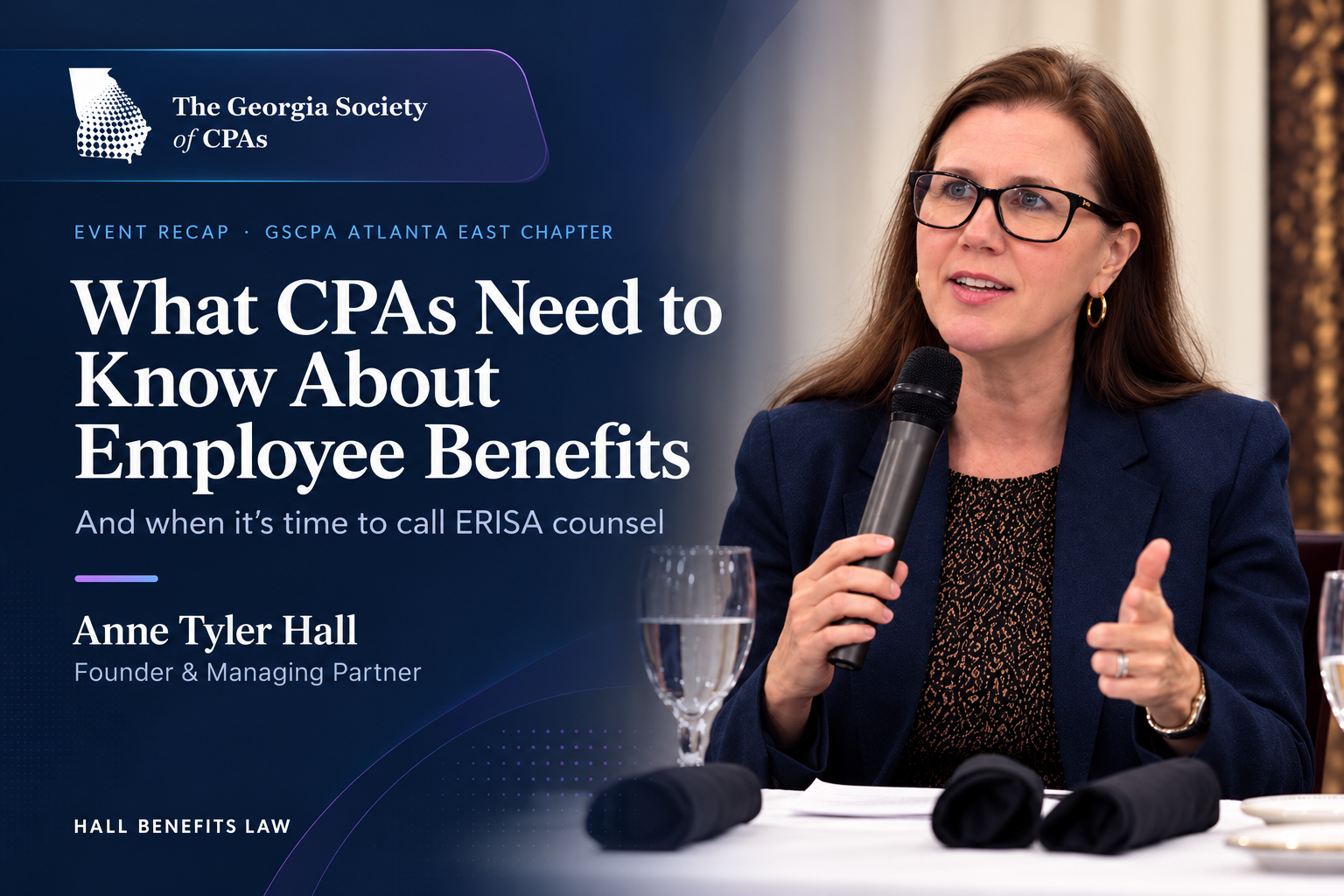
Takeaways from Anne Tyler Hall’s panel with the GSCPA Atlanta East Chapter
On September 29, Hall Benefits Law Founder and Managing Partner Anne Tyler Hall joined the Georgia Society of CPAs (GSCPA) Atlanta East Chapter for an evening panel, “Employee Benefits: What CPAs Need to Know and Who to Call.” Held at Petite Violette in Atlanta, the program was built to help CPAs recognize when an employee-benefit decision calls for specialized guidance.
Anne Tyler was joined by Al Schiebel of ShopBenefits, who helps businesses evaluate health and welfare benefits and manage rising costs, and Vanessa Moore of Zephyr Wealth Management, who works with employers on retirement plan strategy and fiduciary oversight. Marika Ponton moderated. Together with the CPAs in the room, the panel modeled the cross-disciplinary team every well-run plan sponsor should have around the table: a CPA, a benefits broker, an investment advisor, and ERISA counsel.
The starting point was simple. CPAs are often the earliest and most trusted advisor an employer has. They see the financial statements, the payroll data, and the tax filings before anyone else, which makes them a natural first line of defense against benefit plan risk, as long as they know what to listen for.
The Warning Signs That Should Trigger a Call
Anne Tyler pointed to several moments when a CPA should bring ERISA counsel into the conversation:
- A government inquiry. A DOL or IRS letter, a Form 5500 audit finding, or any document request touching the retirement or health plan.
- A change in service providers. Switching recordkeepers, TPAs, or PBMs, or renegotiating a broker contract, is a fiduciary decision, not just a procurement decision.
- Deals and restructuring. M&A activity, layoffs, and plan mergers can trigger successor fiduciary liability, COBRA obligations, and Section 280G “golden parachute” exposure.
- Executive compensation conversations. Deferred compensation, bonus arrangements, or equity at a private or nonprofit client raise Section 409A and 457(f) issues that carry steep, often irreversible tax penalties.
- “Our broker handles all of that.” That sentence is a red flag that sales and fiduciary functions have been combined with no independent oversight.
If a client says they haven’t looked at their plan documents in years, that should trigger the call, not a lawsuit.
The Most Common Mistake: Confusing a Good Broker With a Governance Process
The mistakes Anne Tyler sees most often before an employer calls HBL are not exotic. They are gaps in basic, documented process:
- No fiduciary committee, no charter, and no meeting minutes showing how decisions were made.
- Treating the annual renewal as the entire review, rather than benchmarking fees and services on a regular, documented cycle.
- Late or inaccurate Form 5500s, outdated summary plan descriptions, and missing fee disclosures.
- Assuming a smaller plan is a safer plan.
- No formal claims and appeals process for the health plan.
Having a good broker is valuable. But only a documented governance process is a defense in litigation.
Never Finalize Before You Document
When a client is changing benefits, compensation, or retirement plans, the work that happens before the decision matters most. That means a fiduciary and compliance review of the change, a documented decision-making process (a market comparison, committee discussion, and minutes), a Section 409A review of any executive compensation change before it takes effect, and timely, compliant communication to employees.
It also means coordination. The CPA weighs the tax impact, the broker and investment advisor bring market and investment insight, and ERISA counsel addresses compliance and fiduciary process, so no single advisor is left making decisions outside their lane.
A good decision made without documentation can look, in litigation, exactly like a bad one.
Knowing Where the Line Is
The panel also explored where CPAs most often underestimate the need for outside expertise. Passing nondiscrimination testing answers a tax-qualification question, but a plan can pass its tests and still face a fiduciary breach claim. CPAs rightly own the tax reporting on executive compensation, but drafting the plan and getting its 409A structure right are legal functions. And M&A due diligence treated purely as an accounting exercise can miss fiduciary liabilities that survive the deal.
Perhaps most important: when a CPA moves from explaining options to recommending a specific vendor, fund lineup, or broker, they risk acting as a fiduciary themselves, often without realizing it.
Why This Matters Now
ERISA litigation is no longer just a Fortune 500 problem, or just a 401(k) problem. Encore Fiduciary counted 155 ERISA fiduciary breach class actions filed in 2025, and health and welfare plan cases were the fastest-growing category. Plaintiffs’ firms are increasingly targeting mid-sized and smaller plans, which is exactly where many CPA clients sit, and where governance around the health plan is often thinnest.
The One Question Every CPA Should Ask
Asked what single question CPAs should put to every business client, Anne Tyler offered this:
“Who on your team is accountable, by name, for your benefit plans’ fiduciary decisions, and when did they last document that process?”
That one question surfaces the two things that matter most in a breach lawsuit: whether a real fiduciary process exists, and whether it is documented. If the client can’t answer both halves, that is the opening for a referral.
Work With Hall Benefits Law
Hall Benefits Law is a national boutique ERISA, employee benefits, and executive compensation law firm serving clients across all 50 states. We help employers build and maintain the documented, proactive governance that keeps a demand letter from becoming a crisis, and we partner with CPAs and other trusted advisors to protect their clients.
To talk about a client situation or arrange a conversation for your firm, contact Anne Tyler Hall at athall@hallbenefitslaw.com.
This post is provided for general informational purposes only and does not constitute legal advice. Reading it does not create an attorney-client relationship.