
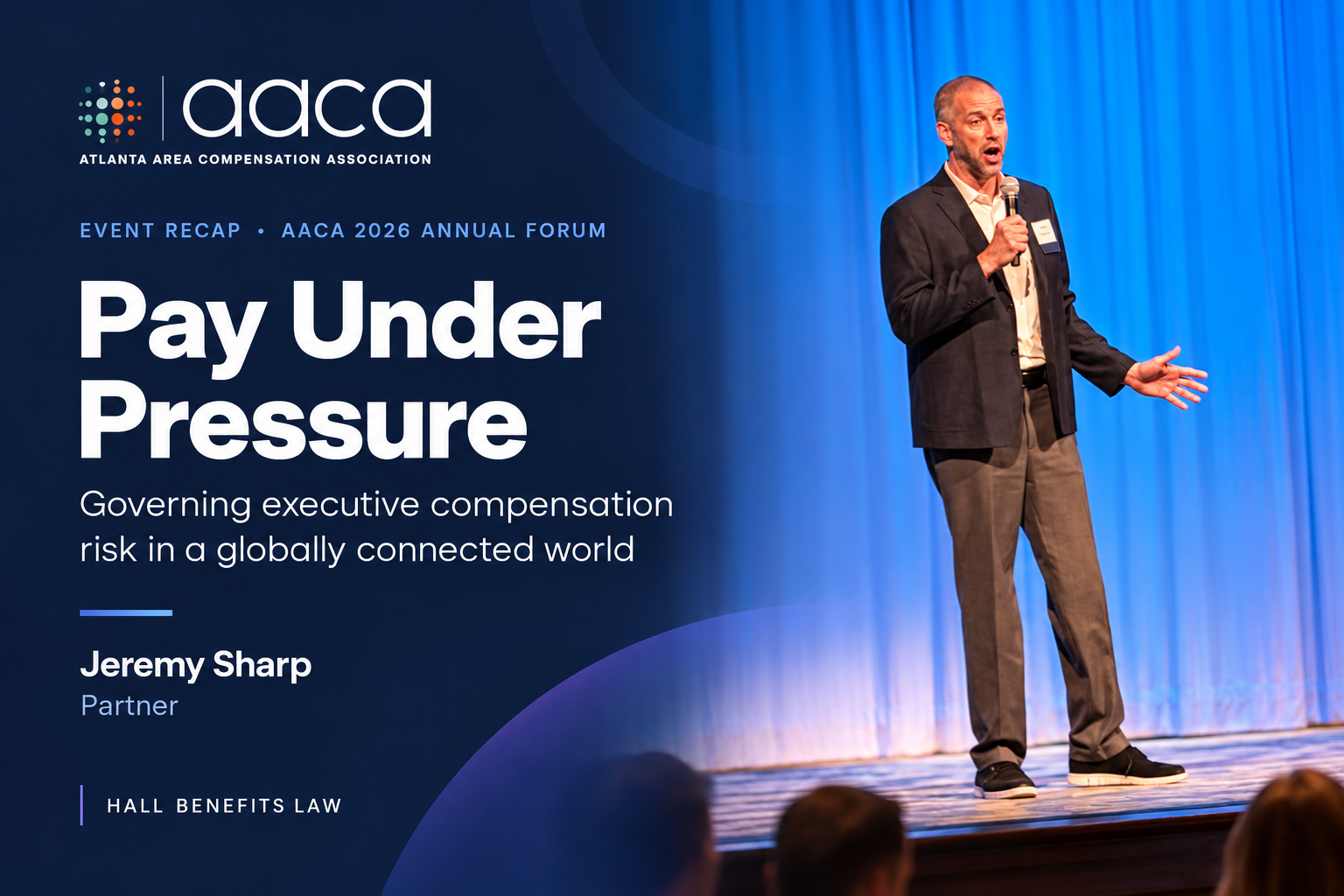
Takeaways from Jeremy Sharp’s session at the AACA 2026 Annual Forum
Hall Benefits Law Partner Jeremy Sharp presented “Pay Under Pressure: Governing Executive Compensation Risk in a Globally Connected World” at the Atlanta Area Compensation Association’s 2026 Annual Forum, themed “Total Rewards in a Globally Connected World.” Speaking to compensation and total rewards leaders, Jeremy traced how today’s business pressures turn into executive pay risk, and what a disciplined governance process does about it.
Download the presentation here:
https://hallbenefitslaw.com/wp-content/uploads/2026/10/aaca_pay_under_pressure-_-final.pdf
Pressure Produces Promises
Disruption is no longer a news cycle. It is an operating condition. Healthcare cost inflation, tariff volatility, regulatory whiplash, AI-driven workforce change, pay transparency, and geopolitical shocks now arrive at the same time and compete for the same total rewards budget.
As pressure rises, key people get harder to keep, so companies make promises: deferred compensation, equity acceleration, retention bonuses, and severance. Every one of those promises is governed by three areas of law. And in each of them, when something goes wrong, the tax falls on the executive rather than on the company that designed the arrangement.
Enforcement is rising on several fronts. The IRS is running an active campaign targeting Section 280G payments in M&A, participants are suing to challenge top hat status, and the plaintiffs’ bar has spent years testing benefit plan governance records. In every case, the defense is not “we made a good decision.” It is a contemporaneous record of how the decision was made.
No One Has the Whole Picture
Executive pay is designed by HR and total rewards, benchmarked by a consultant, approved by the compensation committee, drafted by counsel, executed by payroll, reported by finance, and inherited by deal counsel at a transaction. Nobody in that chain sees the arrangement end to end, and the handoffs are where the exposure sits.
Jeremy pointed to four common breakdowns: documents nobody re-reads, decisions with no record, plan design that drifts from how it is actually administered, and a deal clock that outruns diligence. The fixes are equally straightforward: review documents on a cycle, write the rationale when you decide, reconcile the paper to payroll, and model before terms harden.
1. Who Is in the Plan? ERISA Top Hat Status
Nonqualified deferred compensation plans depend on an ERISA exemption for unfunded plans maintained primarily for “a select group of management or highly compensated employees.” Lose it, and the plan becomes subject to ERISA’s participation, vesting, funding, fiduciary, and reporting rules, and participants gain ERISA remedies. There is no clean fix, because funding the promise to cure the problem triggers immediate taxation.
There is no safe harbor and no magic number. Courts look at how small the eligible group is, whether participants are truly management, and how their pay compares to the company’s own workforce. Some also ask whether participants could negotiate their deals. And because every promotion, hire, reduction in force, and acquisition moves the analysis, top hat status is a test the plan has to keep passing, not a box checked at adoption.
- Re-test the eligible group every year.
- Record why each participant qualifies at the time they are added.
- Treat every acquisition as a re-test event.
2. Does It Run the Way It Reads? Section 409A
Section 409A reaches any arrangement, written or unwritten, that may pay compensation earned in one year in a later year. That includes offer letters, retention emails, board minutes, and informal bonus deals that never sit where anyone looks for deferred compensation documents. A failure makes all vested deferred compensation taxable immediately, adds a 20% federal tax plus interest, and charges it all to the executive.
The most common failure is not a bad election. It is a good election that payroll never implemented, or a key employee list nobody refreshed. The good news is that IRS correction relief is generous for operational errors caught early: a failure corrected in the same tax year generally costs nothing. That relief narrows each year, and after three years no correction program is available at all.
An annual 409A audit is a calendar item, not a project, and the cheapest insurance in executive compensation.
3. What Happens at the Deal? Section 280G
At a change in control, Section 280G creates an all-or-nothing cliff. If payments to an officer, significant shareholder, or highly compensated employee reach three times their base amount (average W-2 pay over the prior five years), everything above one times base is an excess parachute payment. The executive owes a 20% excise tax on it, and the company loses its deduction. Private companies are covered too.
Consider an executive with a $500,000 base amount who receives $1.6 million in change-in-control payments, or 3.2 times base. The $1.1 million excess triggers a $220,000 excise tax on the executive. At 2.99 times, nothing happens. With tax gross-ups now largely gone, the executive bears that cost.
Current market practice is to target cash multiples below the cliff, use double-trigger equity vesting, and include cutback provisions in place of gross-ups. The biggest pitfall is single-trigger equity acceleration buried in plan documents, followed by leaving SERP benefits, deferred compensation acceleration, or transaction bonuses out of the model. The answer is to model 280G exposure before signing, while the structure can still change.
One Calendar Covers All Three
All three doctrines fail for the same reason, and the same discipline prevents all three: a dated schedule with a named owner. Each year, re-test top hat eligibility, self-audit 409A operations against payment records, and refresh the specified employee list. On an ongoing basis, run election windows on schedule and keep minutes that capture the analysis, not just the outcome. And when something happens, such as a new executive hire, an acquisition, a plan amendment, or a deal signing, trigger the right review before terms are final.
Nothing on this calendar is difficult. Everything on it is what was missing in the cases that go wrong.
Work With Hall Benefits Law
Hall Benefits Law is a national boutique ERISA, employee benefits, and executive compensation law firm serving clients across all 50 states. Jeremy advises companies, compensation committees, and executives on executive and equity compensation, top hat plan eligibility and structure, Section 409A compliance, and Section 280G change-in-control planning, including transactional support in M&A.
If your organization would benefit from an executive compensation governance review, a 409A operational audit, or 280G modeling ahead of a transaction, contact Hall Benefits Law to start the conversation.
This post is provided for general informational purposes only and does not constitute legal or tax advice. Reading it does not create an attorney-client relationship.