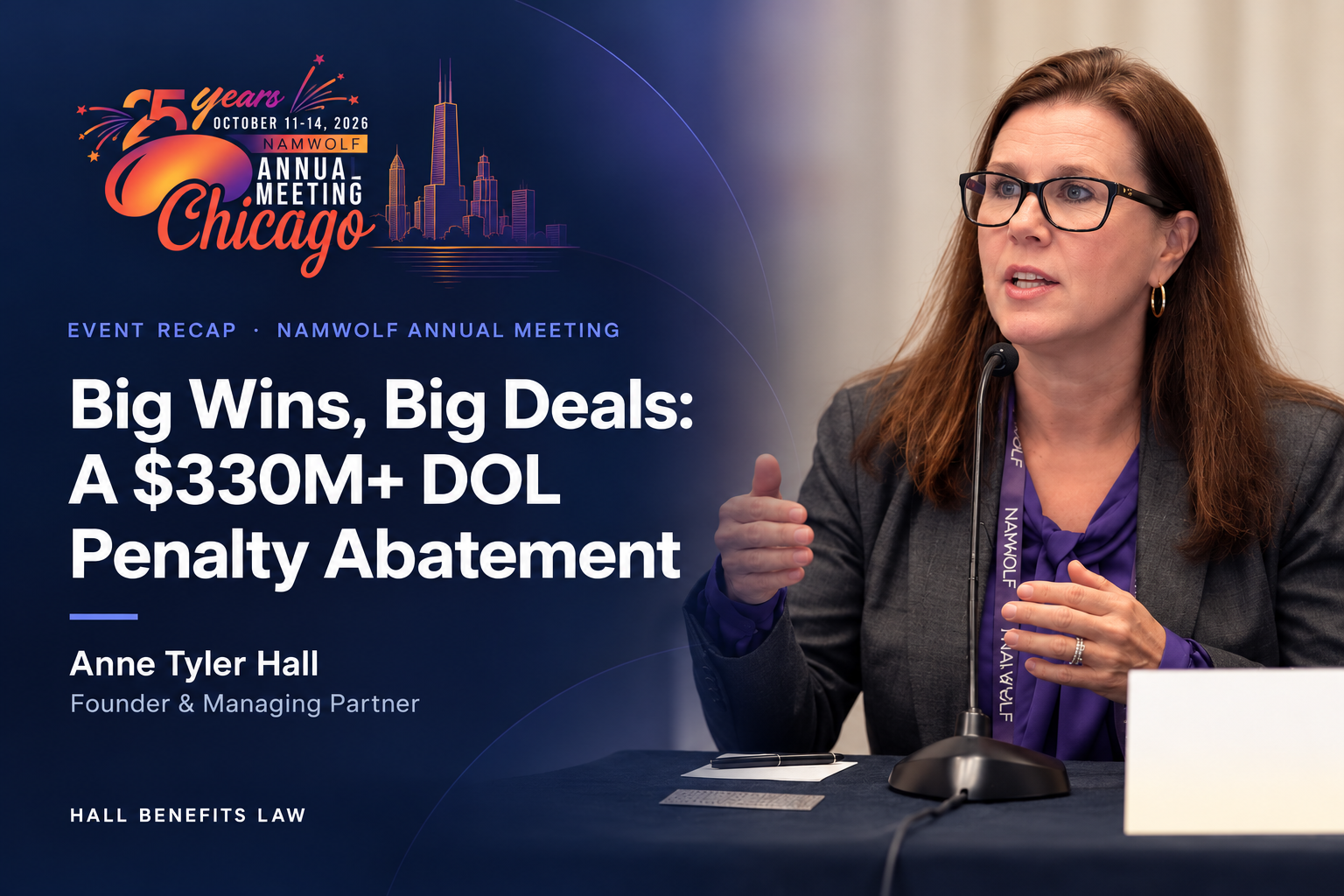
Anne Tyler Hall shares an HBL case study on NAMWOLF’s “Big Wins, Big Deals” panel
At the NAMWOLF Annual Meeting, Hall Benefits Law Founder and Managing Partner Anne Tyler Hall joined the “Big Wins, Big Deals” panel to share one of the most consequential matters in the firm’s history: a multi-year federal investigation that put a global food supplier at risk for more than $330 million in ERISA-related penalties tied to a legacy merger.
The case is a powerful reminder for in-house counsel and deal teams that some of the largest liabilities in a transaction never appear on the balance sheet. They sit in the benefit plans.
Download the presentation here:
https://hallbenefitslaw.com/wp-content/uploads/2026/10/hbl_big_win_dol_penalty_abatement-_-namwolf_annual_meeting_2026-_-final.pdf
The Challenge: Inherited Liabilities and Federal Scrutiny
After a merger, the company inherited serious health plan compliance failures. The Department of Labor took the position that the plan had lost its grandfathered status under the Affordable Care Act as early as 2011 because of changes to plan design and employee contributions. Potential penalties exceeded $330 million, with even a realistic settlement estimated at $30 to $35 million.
The exposure did not stop there. The company also faced questions about COVID-19 testing reimbursements, compliance with the Mental Health Parity and Addiction Equity Act, and the funding of its VEBA trust, all under simultaneous scrutiny from the DOL and the Department of Justice. The purchase agreement offered no protection.
Prior counsel’s verdict before HBL stepped in: the company was “dead in the water.”
The Solution: A Multi-Front Strategy
HBL approached the investigation on every front at once:
- Reframing tobacco surcharges. HBL recast the disputed “tobacco surcharges” as wellness rewards rather than penalties, removing the regulatory basis for the largest fines.
- Rigorous plan document analysis. The team reviewed every plan document and historical change to show where modifications did, and did not, cause the loss of grandfathered status.
- Executive interview preparation. HBL prepared company executives for DOL and DOJ interviews through intensive issue-spotting sessions and mock interviews, so they could answer confidently and consistently.
- Third-party administrator accountability. HBL demonstrated the role the plan’s TPAs played in service failures and negotiated shared responsibility, limiting the client’s direct exposure.
- Proactive corrective documentation. HBL secured limited corrective actions and documented compliance steps, including spot-check commitments and improved VEBA reporting, to demonstrate good faith to regulators.
The Results
The DOL accepted HBL’s arguments on key issues, including the recharacterization of tobacco incentives as wellness rewards and the delegation of administrative responsibility to third-party administrators. The client’s liability was reduced from hundreds of millions of dollars to a small fraction of the original exposure.
The company emerged with a stronger compliance framework, a reduced risk profile, and a successful acquisition, and is on track to transfer full plan administration to a major carrier in 2026. The client’s benefits director described HBL’s executive interview preparation as the best she had ever experienced.
With this matter, HBL has now achieved more than $410 million in penalty abatements for clients since 2018.
Lessons for In-House Counsel and Deal Teams
- Diligence the benefit plans, not just the financials. Health and welfare plan failures can follow the buyer long after closing, and a purchase agreement that is silent on them leaves the liability unmanaged.
- Plan history matters. Years-old changes to plan design or contributions can determine today’s exposure. A complete document history is often the strongest defense.
- Hold vendors accountable. When administrators contribute to compliance failures, their role belongs in the conversation with regulators.
- Prepare people, not just paper. How executives answer federal questioning can shape the outcome as much as the legal arguments.
- Document good faith. Proactive, well-documented corrective steps show regulators a company that takes compliance seriously.
When hundreds of millions are at stake, specialized benefits counsel, transparent communication with regulators, and experienced advocacy make the difference.
Read More Case Studies
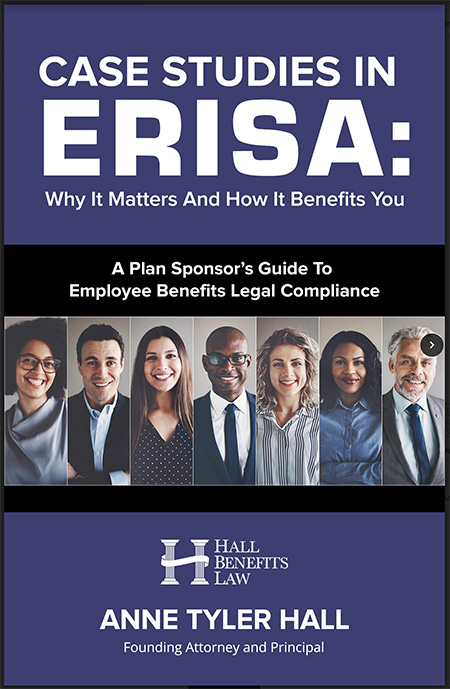
This matter is one of the case studies featured in Anne Tyler’s book, Plan Sponsor Compliance Book: Case Studies in ERISA. Get a digital copy at hallbenefitslaw.com/book.
Work With Hall Benefits Law
Hall Benefits Law is a national boutique ERISA, employee benefits, and executive compensation law firm serving clients across all 50 states. Beyond penalty abatement, HBL has secured more than $42 million in TPA, PBM, and broker fee concessions for group health plan clients since 2022. If your organization is facing a DOL inquiry, evaluating benefit liabilities in a transaction, or simply wants to know where it stands, we can help.
Contact Anne Tyler Hall at athall@hallbenefitslaw.com or +1 (470) 571-1007.
This post is provided for general informational purposes only and does not constitute legal advice. Reading it does not create an attorney-client relationship. Prior results do not guarantee a similar outcome.